

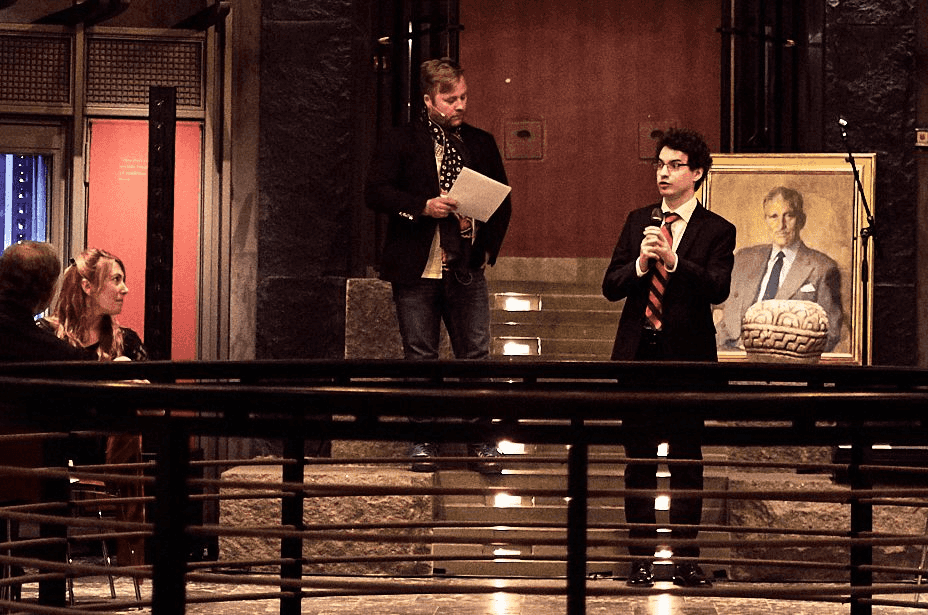
Photo: the Ragnar Söderberg Foundation.
Valentin Jeutner, a legal scholar with a philosophical approach, is an assistant professor at the Faculty of Law at Lund University. Although still young, he has already followed a remarkable path towards his research on the highly topical subject of artificial intelligence.
Valentin Jeutner was born in East Berlin in November 1989, just one week after the fall of the Berlin Wall. His parents, both theologians, were among those who had been dissatisfied with the lack of freedom in East Germany.
“We often had political discussions at home. From an early age, I became accustomed to reasoning and arguing, something that continues to shape me today and is valuable in my research,” he says.
His parents had faced limited opportunities to practise their professions and to travel freely.
“They have encouraged me to make the most of opportunities they never had themselves. That is a powerful driving force. I have seen how the dissatisfaction of my parents and others actually brought down an entire state, and that getting involved can make a difference.”
When Valentin Jeutner was one year old, the family moved to Greifswald on the Baltic coast. The move seems almost prophetic, as the city belonged to Sweden during its era as a great power and is a twin town of Lund. The family eventually moved to Hamburg, after which Valentin Jeutner embarked on his international journey.
He began studying at Atlantic College in Wales, the first school in the United World Colleges movement, now a global network of secondary schools dedicated to promoting understanding and peace between people.
“I was attracted by the dynamic environment, with students from different countries, cultures, religions and social backgrounds. The school was like a miniature United Nations. There were Chinese and Tibetan students, Israelis and Palestinians, and so on. There were always intense discussions, which suited me perfectly. I was already engaged and driven, and I also wanted to become a diplomat.”
After graduating, Valentin Jeutner considered studying history, philosophy or law. He chose law and spent three years at Oxford, specialising in international law.
“I usually call them ‘the dark years’. The studies were extremely demanding. It was dark when I went to the libraries in the morning and dark when I returned home.”
He had long been interested in computers and their possibilities, and had done some programming himself.
“I first encountered artificial intelligence, AI, at Oxford when I was studying criminal law. In law, determining whether a person has acted reasonably is central to questions of liability. In English, this is expressed through the concept of the ‘reasonable person’. I found that fascinating. Who exactly is this archetype, this reasonable person? Even then, I was wondering whether the archetype could be applied to questions of legal responsibility involving AI,” he says.
“Digital algorithms can be made rational relatively easily, but incorporating reasonableness is much more difficult. It would be extremely useful if we could develop decision-making rules for robots based on the assumption that a robot is a legally reasonable person. That would mean robots would not have to be programmed for every conceivable situation. Instead, they could apply general principles themselves and adapt their behaviour to the circumstances.”
After completing his Bachelor of Laws at Oxford, Valentin Jeutner moved to Washington, D.C., to pursue a one-year master’s degree at Georgetown University.
“The difference compared with Oxford was enormous. The sun shone almost every day, it was warm most of the time, and I had considerable freedom to choose my courses.”
During the summer after Georgetown, Valentin Jeutner passed the New York Bar Examination. He then returned to the United Kingdom to pursue doctoral studies at Cambridge, focusing on “impossible” problems.
“I studied contradictions between the sovereignty of nation states and international agreements. If the right to self-defence conflicts with a prohibition on nuclear weapons, what should a state do?” he asks rhetorically.
“My aim is to make people aware of important questions and encourage them to think, rather than simply provide answers. Even questions that cannot be resolved can be handled better if we have a deeper understanding of the situation and what is at stake.”
He arrived in Lund in 2016.
“After ten years in the United Kingdom, it was time to leave Oxford and Cambridge, which exist in something of a bubble. I applied for a postdoctoral position in Lund and received a very warm welcome. I had also spent many summers in Sweden visiting my paternal grandparents, who had recently moved to Emmaboda in Småland.”
Today, Valentin Jeutner devotes his research entirely to artificial intelligence. Since 2017, he has received support from the foundation through an assistant professorship. His research focuses on the programming process from a legal perspective.
“The aim should be to programme systems to act as a reasonable person would. But I realise how little we actually understand about what computers do. That is problematic. I therefore want to raise questions about responsibility in an increasingly robotic world. Who can be held accountable if something goes wrong?”
An important part of his work involves identifying situations that may arise. Valentin Jeutner does this by studying extensive amounts of literature, academic articles and news reports. He also meets many people, particularly those working in the IT sector.
“Some are sceptical about the idea of their activities being restricted through regulation and argue that lawyers do not understand technology. But my view is that everything can be regulated. That does not necessarily mean it should be.”
For his research, Valentin Jeutner has formulated a series of questions, all centred on his distinctive approach of comparing robots with reasonable human beings. The main focus is on the advantages and possibilities of programming robots to behave just like their human counterparts.
His vision is to identify a set of legal principles that should govern the use of robots. One of the questions he explores concerns what robots should be permitted to do.
“Some decisions simply should not be delegated to algorithms. Sometimes human intervention is necessary. Part of my work involves identifying those situations. One example might be a decision about a high-risk surgical procedure, with a 50–50 chance of success or death. I think most people would want that decision to be made by a human being rather than a robot,” he says.
Another question concerns how rules should be formulated and communicated to robots: through detailed instructions or general principles. And who should oversee the creation of the software code that controls robots – software experts or democratically elected members of parliament?
“Software affects our lives in far-reaching ways. It should be possible to envisage some form of licensing for programmers, similar to that required for lawyers or doctors. Training in ethics should also be a natural part of their education.”


