

Meet a researcher
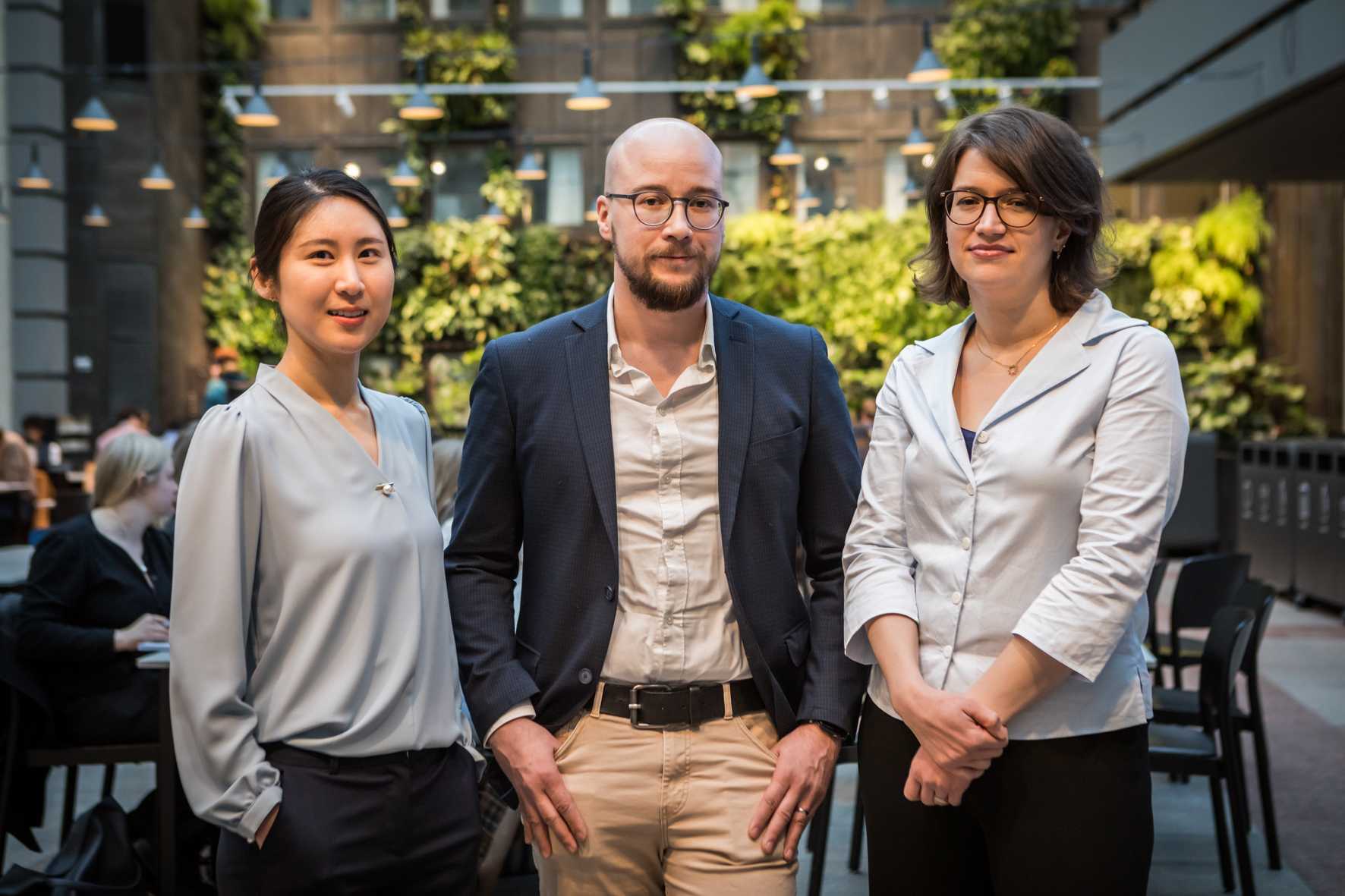
Photo: Angelika Klang.
The researchers in this project will study the factors that influence women’s representation in politics and democratically elected bodies, and what happens when women gain greater representation in politics.
“In 2025, we received a project grant in economic sciences from the Ragnar Söderberg foundation for the project The political economics of parity: Why women’s representation stalls and how to move beyond it,” say Jaakko Meriläinen and Céline Zipfel, who are based at the Department of Economics at the Stockholm School of Economics. Together with Jay Euijung Lee from the Department of Economics at Stockholm University, they are working on the research project, which consists of four parts.
The project highlights that women’s political representation is not simply a matter of laws or electoral rules. It is also influenced by technological development, attitudes, institutional reforms and social norms. The aim of the research is to generate new knowledge about how democracies can become more inclusive and what is needed to achieve equal representation.
The milking machine changed politics
In the first part of the project, the research group will study the factors that have driven women’s representation in elected bodies. By analysing historical data, the researchers aim to investigate how technological advances have helped women enter politics.
During the twentieth century, women’s role in society changed dramatically. They went from working primarily in the home to participating in the labour market on a large scale. Much of this change was driven by technological innovations that saved time and transformed everyday work. Jaakko’s interest in researching this area stems from a story his grandfather told him when he was a child.
“My grandparents were farmers in Finland, and my grandmother was responsible for milking the cows. When the family acquired a milking machine, my grandmother’s life changed. My grandfather took over the milking with the help of the new machine. Suddenly, my grandmother had more free time and became involved in local political organisations. This kind of change may have given many more women additional time, higher status and greater opportunities to become involved in politics,” says Jaakko.
Is a ‘zero-sum’ mindset holding back gender equality?
In the second part of the project, the researchers will analyse whether attitudes stand in the way of equal representation. They start from the theory that political representation is a zero-sum game – in other words, that increased representation of women comes at the expense of men’s representation.
“We will test the theory through surveys and interviews with voters and party leaderships in places where women’s representation has stalled before reaching 50 per cent. We will conduct experiments in which we measure attitudes and investigate whether they can be changed by providing information,” says Céline.
Do gender quotas build or undermine trust?
“In the third part of the project, we will investigate what happens when equal representation is achieved through institutional measures. We will study how gender quota legislation affects citizens’ trust, confidence and attitudes towards the political system and politicians. We want to find out whether greater representation of women through quotas leads to increased participation and influence. Since trust is a cornerstone of well-functioning democracies and economies, this is an important question,” says Jaakko.
“We are investigating what actually happens when quotas are introduced. Using international data, we compare countries before and after quota reforms and analyse how citizens’ trust in political institutions is affected. The underrepresentation of women in politics can have consequences across all areas of society. Our aim is to work on these important questions, which the group has been thinking about for a long time,” says Céline.
Do women gain real influence?
“I came up with the idea for the fourth part of the project when I returned home to South Korea in 2018. I became interested in the issue ahead of the election, when gender quotas were being debated. Many men were unhappy with the quotas and felt that the women had not earned their positions. It became clear that gender quotas divided the population,” says Jay.
In 1992, women made up two per cent of members of local political assemblies in South Korea; today, the figure is 40 per cent. Minutes from local council meetings are available for all 226 municipalities in South Korea, covering the period before quotas were introduced through to the present day. The group will analyse these records with the help of an AI assistant.
“I wanted to explore the consequences of gender quotas further and understand the thinking of those who designed the legislation. Having a seat in an assembly does not automatically mean having influence. Research shows that people who belong to a small minority often speak less and have less impact.
We are now analysing minutes from local council meetings in South Korea to see how women’s participation changes as their share of representatives increases,” Jay concludes.
Jaakko is assistant professor of economics at the Stockholm School of Economics. He is also a docent at the University of Helsinki and an assistant professor affiliated with the House of Governance and Public Policy and the KAB Center for Governance at the Stockholm School of Economics. Jaakko received his PhD from the Institute for International Economic Studies (IIES) at Stockholm University. Before that, he studied at the University of Helsinki, where he completed both his bachelor’s and master’s degrees.
“My research field is political economy, with a particular interest in democratic governance and economic and political development. I often combine microeconometric methods with contemporary and historical data from both developed and developing countries,” says Jaakko.
Jay is assistant professor at the Department of Economics at Stockholm University and an affiliated researcher at the Centre for Economic Performance at the London School of Economics and Political Science. She received her master’s degree and PhD in economics from the London School of Economics. Jay’s research focuses on how institutions, family structures and gender norms affect economic development and growth. Among other areas, she studies family economics and gender economics, often combining historical data with modern empirical methods.
“I’m from South Korea, but my father worked for an international development organisation, so we travelled a lot and I attended international schools while growing up. I later studied in England before moving to Stockholm,” Jay explains.
Céline is assistant professor of economics at the Stockholm School of Economics. She received her master’s degree and PhD in economics from the London School of Economics and Political Science, as well as a master’s degree in International and Development Economics from Yale University in the United States. She is also an affiliated researcher at the House of Sustainable Society at the Stockholm School of Economics.
Under the heading Meet a Researcher, we publish interviews with researchers who have received funding from the foundation. Earlier this year, we interviewed Antoaneta Momcheva and Iman Parsa, Monica Svantesson, Daniela Calvigioni, Autilia Arfwidsson and Emma Bell.
Last year, we interviewed Eszter Lakatos, Alexander Pietras, Julian Nowag, Hanna Almlöf, Konrad Burchardi, Sofia Lodén (Young Academy of Sweden) and Anni Carlsson.
In 2024, we interviewed Agnes Hellner, Anna Brattström, Erik Lindqvist, Suraya Kazi, Mia Phillipson, Wei-Li Hong, Vicente Pelechano and Annika Lindskog.


